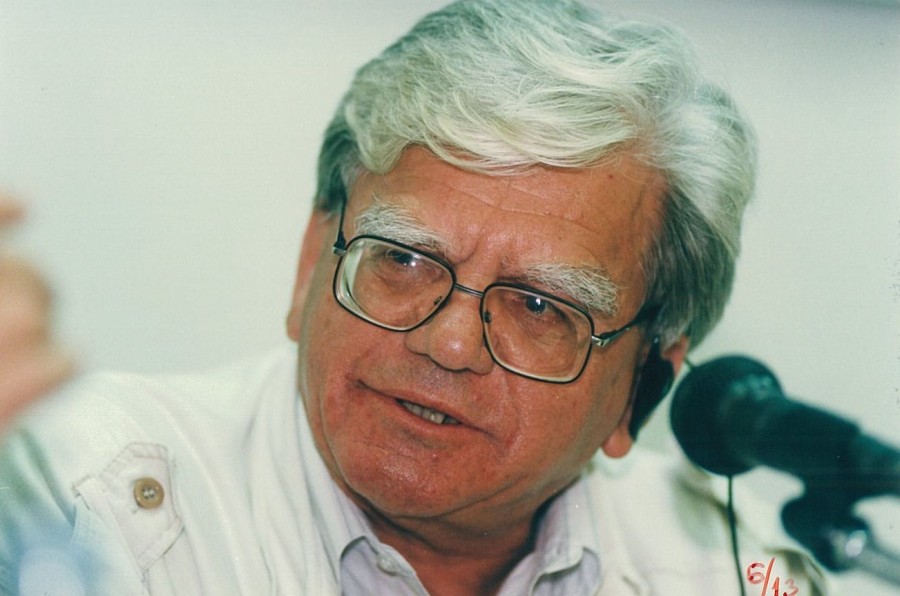
Showing posts with label Karel Kosik. Show all posts

Sunday, 19 January 2020

Vek Franca Kafke

With a great preface Somewhere behind Milan Kundera, a close friend of Czech philosopher Karel Kosik (1926-2003), whose collection of essays is in front of readers (in Ilić's selection and translation), Franz Kafka's book Century deals with philosophical and literary topics.
Kosik, who experienced both fascism and communism, played a significant role in the Prague Spring of 1968, then lost his professorship at Charles University and had to change professions, known to local readers for his books Dialectics of the Concrete and Dialectics of Crisis.
In this book, as editor Jelena Majstorov puts it, “Kosik considers and comments on Kafka's belief that the modern age is hostile to the tragic, in whose place it places the grotesque. The attitude that we live in the post-heroic era is elaborated on the examples of the works of two great writers, Franz Kafka and Jaroslav Hasek, and their heroes Joseph K. and Joseph Schweik.

Wednesday, 1 January 2020

Karel Kosík. Dialektika, kultura a politika


Čtvrtý svazek Sebraných spisů Karla Kosíka zahrnuje články, eseje, rozhovory a kratší příležitostné texty pocházející z let 1955 až 1969. V první části jsou shromážděny stati, jejichž prostřednictvím Kosík vstupoval do polemik o marxismu, o aplikaci marxistické metody i o negativních jevech socialismu. Předestírá zde svoji koncepci dialektiky vycházející z Hegela a Lukácse a načrtává obrysy vlastní verze marxistické teorie, která je v jeho pojetí společenskou kritikou. Druhou část tvoří články, v nichž Kosík dialektiku aplikuje na konkrétní fenomény umění a kultury. V analýze literárních děl (Hemingwaye, Kafky či Haška) rozvíjí úvahy o společenské roli kultury, politice, humanismu apod. Předkládaný svazek představuje Karla Kosíka jako veřejného intelektuála, který se vyjadřoval k aktuálním tématům své doby i k nadčasovým otázkám lidské existence.

Karel Kosík (1926–2003) byl významný český filosof, který se věnoval především marxistické filosofii a historiografii českého politického myšlení 19. století (Česká radikální demokracie, 1958). Proslavil se knihou Dialektika konkrétního (1963), která byla přeložena do řady světových jazyků a dodnes patří k nejcitovanějším českým filosofickým pracím. V letech 1970–1989 nemohl pracovat v oboru. Po roce 1989 vydal několik esejistických souborů: Století Markéty Samsové (1993), Jinoch a smrt (1995) a Předpotopní úvahy (1997); posmrtně vyšel svazek Poslední eseje (2004).

J. Mervart (ed.): "Karel Kosík. Dialektika, politika a kultura. Eseje a články z let 1955-1969". 291 stran, 265 korun.

filosofia.flu.cas.cz/publikace/522

Tuesday, 7 August 2018

Karel Kosik, philosophe insoumis

KAREL KOSIK, philosophe insoumis
1er mars 2004
Karel Kosik and his family.
Karel Kosik est non seulement un des plus importants philosophes de la deuxième moitié du XXe siècle, mais aussi un de ceux qui ont le mieux incarné l’esprit de résistance de la pensée critique. Il est aussi un des rares qui ont combattu, dans leur succession, les trois grandes forces d’oppression de l’histoire moderne : le fascisme, au cours des années 1940, le régime bureaucratique stalinien, à partir de 1956, et la dictature du marché, depuis 1989. A une époque où tant de penseurs ont abdiqué de leur autonomie pour servir les puissants de ce monde, ou se sont détournés de la réalité historique pour se livrer à des jeux de langage académiques, Kosik apparaît comme un homme debout, qui refuse de s’incliner, et qui n’hésite pas à penser, contre le courant, les grands problèmes de l’époque.
Karel Kosik est né à Prague en 1926 au sein d’une famille ouvrière. Comme jeune militant du Parti communiste tchèque, il participe à la lutte clandestine de résistance contre le nazisme au sein du groupe dont faisait partie l’écrivain et combattant communiste Julius Fucik, auteur du célèbre Reportage au pied de l’échafaud, exécuté par les occupants. Arrêté par la Gestapo en 1944, Kosik sera d’abord enfermé dans la prison de Pankacic et ensuite déporté au camp de concentration de Terezin, où il restera jusqu’à la fin de la guerre. Soumis aux travaux forcés, il réussit à établir un réseau de correspondance avec l’extérieur grâce à la complicité d’une ouvrière allemande des chemins de fer.
Après la libération de la Tchécoslovaquie, le jeune Kosik a choisi d’étudier la philosophie, d’abord dans sa ville natale. Son prémier maître fut Jan Patocka, qui enseignait Husserl et Heidegger dans les années d’après-guerre à l’Université de Prague. Malgré leurs différences philosophiques, Patocka avait beaucoup d’estime pour son « ami marxiste », dont il dira plus tard qu’il est « le plus important représentant de la philosophie tchèque de l’époque actuelle ». Comme il était l’habitude à l’époque dans les pays de l’Est, Kosik a continué sa formation philosophique à Moscou et à Leningrad entre 1947 et 1949. De retour à Prague, il publie en 1953 Démocrates radicaux tchèques, une anthologie des insurgés de la révolution de 1848 précédée d’une introduction de sa plume. La parution de son premier texte philosophique – un article sur Hegel dans le cadre d’un débat sur la philosophie marxiste —coïncide avec l’année emblématique de 1956, celle du XXe Congrès du PC soviétique dans lequel Kroutchev dénonce les crimes de Staline et lance ainsi le processus de la « déstalinisation ».

Tuesday, 3 October 2017

The Kosik-Sartre Exchange

On 28 April 1975, the police conducted an investigation into Karel Kosik's apartment and seized some of his manuscripts. This text is the letter (published by Le Monde on 29-30 June 1975) sent  by Karel Kosik to Jean Paul Sartre on this incident ,on 26 May of the following year.

The Kosik-Sartre Exchange


Dear Jean-Paul Sartre,

The event of which I will tell you in this open letter is of the most banal sort and without any interest for the sensationalist press. But it is not to the devotees of the sensational that I address myself. It is to you. And, through you, to my socialist, democratic and communist friends who are also friends of Czechoslovakia. I am not addressing you an appeal or a protest, but one single question which has a vital importance for me:
Am I guilty?
This question haunts me since April 28, 1975, that is to say, since the day the police searched my apartment for six hours and confiscated more than one thousand pages of my philosophical manuscripts.
Given the fact that the search was made under the pretext of a suspicion that I had hidden in my apartment writings which would constitute evidence of a criminal activity, "subversion of the Republic," I must assume that I am threatened with a prison term of from one to five years, as provided by Article 98 of the penal code. I do not underestimate the significance of this threat, but what troubles me more is the eventual fate of the manuscripts confiscated from me.
For the last six years I have had to live in a very peculiar situation: my existence has taken two forms—I am and I am nothing. I am dead and, at the same time, I am alive. In the domain of the elementary rights of the citizen and the man, I have been reduced to a mere nothing, and at the same time, I have been graced with an exceptional existence as far as the overabundance of care and attention from the police is concerned. I am a mere nothing and that is why I cannot teach philosophy at the Charles University, nor be employed anywhere or elsewhere in accordance with my qualifications and in my specialty. I am dead, and that is why I cannot participate in any of the scholarly meetings to which I am invited, nor accept invitations to teach in European universities. As someone who is not and never was, I must not lead my
readers into error and that is why all my publications are banned, kept out of the libraries in Czechoslovakia. And my name has been censured in the list of authors. I do not exist and that is why official institutions are under no obligation to answer my complaints and protests. From another point of view, I exist, even in excess. As is shown  by the police searches and interrogations which are becoming ordinary events. As a philosopher and an author, I am stripped of basic rights and I live as an accused and a permanent suspect.
I am a suspect although I have committed no criminal act. Why then am I suspected? Because I consider the exercise of thought to be an inalienable human right and exercise this right. Because  I consider inalienable the right of every man to have his own opinion and to be able to express and communicate it. Because I consider that every man should be able to keep a spine as a basic human right.
Why am I a suspect?  Because in an environment of generalized suspicion, the most specifically human values and the most commonly shared ones, such as for example, friendship, honor, humor, the sense of politeness, spontaneity and sincerity, become provocations; normal words and the simplest things take on a subversive meaning.
The simple sentence: "I twisted my ankle and I limp," seems to the ears of the police to be a password for a conspiracy. And he who really limps is in the eyes of the police a mere faker who hides a "dark" activity. In such an atmosphere, publicly proclaimed rights are immediately limited or even completely denied: everyone has the right to think, but he who reflects without permission and without being ordered to, or who does not think as he ought to think, awakens suspicion. Everyone can have his opinion, but he who refuses to accept opinions that are imposed and unjustified, that are foreign to his own—which latter have some basis—and who persists in demanding a rational and free discussion, becomes suspect. Everyone has the right to have a spine, but if he does not "voluntarily" and without dignity make a mea culpa which defiles him, he has no hope of being able to publish or to find the sort of work for which he is qualified.
The manuscripts seized by the police were not even destined for publication. In the event it is a matter only of unelaborated working notes, preliminary studies relating to the preparation of two works which will be titled: the first, On Practice, and the second, On Truth. These manuscripts contain only opinions, opinions expressed by others in whom the police are not interested, and mine, which the police already know from my previous books and my articles. I would like to be able to believe the officer of the State Police when he told me that after examination these manuscripts would be
returned to me. But, well, how much time does the police need to "study" a thousand pages of a philosophical manuscript?
To that, other much more serious facts must be added. The police have also confiscated the manuscripts of my friends, the writers Ivan Klima and Ludvig Vaculik. And I must ask the question: April 28, 1975, was I not the witness to events which foreshadow the gravest consequences for Czech culture? On that day did they not make a trial run of the effectiveness of new perfected methods in comparison with which the censorship in force up to then was only a pitiful liberal game? Does not April, 1975, mark the attempt to impose on society a new habit, a new "normality" — the regular confiscation of manuscripts? Might this habit not very rapidly become—in the country of  Franz Kafka—so natural, so necessary a consequence of indoctrination that the writers themselves will call the police to take away completed works? I am not a partisan of these innovations. Up to today I have not received a reply to my request for the return of the manuscripts. Up to now I have kept silent about the discriminatory measures of which I have been the victim, because my person alone was attacked and this did not endanger the basis of my existence—the possibility of thinking and writing. This time, in the case of the confiscation of my philosophical manuscripts, I do not want to remain silent. Because I do not want to be guilty! I would be complicit if I limited myself to watching silently the way a sword of Damocles is held over the heads of all the writers of Czechoslovakia—the threat that the police can take away at any time from any writer a manuscript in progress or
completed.
There is still time to eliminate this threat. I have not lost all hope in the rationality of the responsible leaders in Czechoslovakia. I count on the lucidity and the conscience of the socialist, democratic and communist friends of Czechoslovakia. Accept, dear friend, my most cordial regards,

Karel Kosik


Dear Friend,

If I have taken so long to reply to you, this is because your letter did not reach me. I read of it only a brief fragment in Le Monde and I had some trouble finding it. That's been done now.
I will reply immediately to your question: no, you are not guilty. Your letter would suffice to prove your innocence, not only to me, but to all the friends of invaded and humiliated Czechoslovakia. If there is a thing of which I am certain, it is, as you put it, that every man has the original right and duty to think for himself; and if I, like everyone, have often defended collective ideas, it was because they had penetrated me and because I had compared them to my personal ideas, evaluated and judged them true, in short, because they had become mine.
No government is qualified to judge the thoughts of a citizen. It would do so, in any case, not in terms of thoughts but of pseudo-thoughts. I call true thoughts those which are born from you, or ideas which you have freely examined, found right and made your own. I call pseudo-thoughts the theses supported by your government, and which have never been produced or examined by the thought of a free man, but which are made up of words collected in Soviet Russia and thrown over activities in order to hide them and not to discover their meaning.
These false thoughts are nothing but forces which can only impose themselves with the support of that other—real and material—force: the police. It is to this that criminal leaders wish to reduce Czechoslovak culture. This abomination, or rather this stupidity, cannot last long while there are men like you, my dear friend, to denounce it. For, free thought can be suppressed for a moment by police violence, but as such thought constitutes the only means by which man can grasp his situation and the
procedures that can change it, it would be necessary either to suppress man or to reject
definitively false thoughts.
I cannot commit anyone but myself; but I have discussed your precious and unhappy country sufficiently often and at length to be able to assure you that you have numerous friends who will say with me: "If Karel Kosik is guilty, then all men (not only intellectuals, but farmers and workers) who think about what they do are equally guilty." It is on the basis of this simple idea that we will have to consider activities by which, in helping you, we will help ourselves.
I assure you, my dear friend, of my fraternal sentiments,


Jean-Paul Sartre

Friday, 30 June 2017

Grete samsa, the anti-Antigone of modern times

Antigone vesrus anti-Antigone


«The central figure in Kafka’s story Die Verwandlung (the “Metamorphosis”) written in 1911 is not Gregor Samsa, who metamorphoses overnight into an enormous insect-like creature (“ein ungeheueres Ungeziefer”), but his sister Greta. She actively intervenes in the storyline and her actions bring about its real turning points and twists—i.e., transformations. The grotesque metamorphosis occurs at the moment when Greta Samsa stops treating her brother as a human being, ridding herself of doubt and indecision over whether he is a human being or an animal, and his presence becomes unbearable to her. At this moment Greta abandons her brother and renounces him as a human being: it is no longer her brother lying in the adjoining room, but some king of freakish monster (“ein Untier”). It is only logical that Greta Samsa, a modern anti-Antigone, does not bury her brother herself, but leaves it up to the charwoman to make sure his remains are cleaned up (“wegschaffen”) and disappear from the face of the earth. A person did not pass away, rather an animal died, perished, croaked. The servant woman says of the dead Gregor Samsa: “ … es ist krepiert, da liegt es, ganz und gar krepiert!” When relations between people become so depersonalized that they consider each other to be pestilent insects, it would be grotesque to bury the remains of the people-non-people, these human insects, because it corresponds to their state—i.e., their grotesque transformation, that a funeral cannot be arranged for them—but they will be cleared away with banal utensils, a broom, a shovel and a rag, and disposed of prosaically. “Es” and “krepieren”—these are the appropriate expressions for dealing with grotesque metamorphosis.

But because people, even in their inhuman form, are endowed with consciousness and language, they must justify their actions in some manner—to themselves and to others. And Greta Samsa, the anti-Antigone of modern times, deliberates out loud as follows: Gregor Samsa is no longer her brother, nor a human being. If he was her brother and a human being he would show consideration for the family, would not disturb its peace and quiet, and would voluntarily clear himself away from the house.

For the family, including Greta Samsa, wishes to have peace and quiet (“seine Ruhe haben”) and everything that disturbs this peace is disgusting, repellent, must get out of the way, must be cleared away. And absolutely nothing may be allowed to unsettle this peace, not even death: death has lost its shocking power, it is powerless against the established routine, the ordinary peace which people come to rely on. Greta Samsa personifies this unshakable “peace and quiet” of modern times which cannot be upset by anything and therefore strides toward its goal—over dead bodies. The young body of Greta Samsa, her exuberant, pugnacious, and prolific youth, shakes off everything that could threaten its irrepressible growth, including her brother’s death, and there is nothing, absolutely nothing that could spoil this growth and proliferation. Not shocked by anything, unshakable by any death, the bereaved relatives of Gregor Samsa stride onward, even after the death of a brother and son they are entirely preoccupied with “prospects for the future” (“Aussichten für die Zukunft”) which are, as has now become apparent after the death of son and brother, “highly advantageous and most promising, especially in the longer term” (“überaus günstig und besonders für später vielversprechend”).

Greta Samsa, not upset by anything, not even her brother’s death, strides toward her future which is a reproduction of the past, and thus her next life will thus only be a repetition of sterility, narrow-mindedness, past routine, and she will put all her youthful energy into this sterile repetition.

That is why Kafka’s “metamorphosis” is ironic and grotesque on many levels and has many meanings. People have already been so transformed and imprisoned in banality, everyday routine, narrow-mindedness, the pettiness which they consider to be “normality” and ordinariness, that they do not have the power, the willingness or the will to liberate themselves from these degrading circumstances and thus to really and truly transform themselves. Gregor Samsa metamorphoses into an insect overnight, but this external and naturalistic transformation only emphasizes that internally and spiritually he remains within the banality and constriction of his life thus far. He has only changed form, but his self has not metamorphosed. Death is degraded and not even it has the power any longer to wrest people from this banality and narrow-mindedness.

But is the power of banality on the march, striding even over dead bodies, as personified by the figure of Greta Samsa who is the anti-Antigone of modern times, really so omnipotent that it can exclude all possibility of the tragic and in its victorious crusade through the world will sweep every possible Antigone aside?

I had to bring the situation to a head in this way to be able to make the initial question about the possibility, or impossibility, of the tragic in our times more precise and reformulate it into another question: Who if anyone can revolt against the real or imaginary omnipotence of Greta Samsa, who will defy her, the modern Antigone?»


From 

Democracy and the Myth of CaveKarel Kosík

Thursday, 23 March 2017

Adolfo Sánchez Vázquez


Adolfo Sánchez Vázquez (September 17, 1915 – July 8, 2011) was a Spanish-born Mexican philosopher, writer and professor born in Algeciras, Andalucia.

Biography


After studying philosophy at the University of Madrid, Vázquez emigrated to Mexico in 1939 with thousands of other intellectuals, scientists and artists following the defeat of the Republic in the Spanish Civil War, in which he participated as editor of the central publication of the Juventudes Socialistas Unificadas (JSU) “Ahora”. Sánchez was appointed a full-time professor of philosophy at the National Autonomous University of Mexico in 1959, becoming a professor emeritus of the university in 1985.[3] Sánchez also held honorary doctoral degrees from the Universidad Autónoma de Puebla and the University of Cádiz (Spain). 

He embraced Marxism, although an open, renovating, critical and non-dogmatic version of it. His fresh interpretation of Marxism ran parallel to that of the Frankfurt School. In fact, The Philosophy of Praxis was published at around the same time as Herbert Marcuse was writing his One Dimensional Man]]. In regard to ethics, he opposed normativism.

Monday, 6 February 2017

Karel Kosik

Region  Western Philosophy
Notable ideas  pseudo-concrete
Role  Philosopher
School  Marxism, Neomarxism
Name  Karel Kosik
Influenced  Reception theory
Karel Kosik Dialctica de lo concreto Karel Kosik
Born  26 June 1926 Prague, CzechoslovakiaEra  20th-century philosophy
Main interests  Social philosophy, Politics, Ethics, Aesthetics
Died  February 21, 2003, Prague, Czech Republic
Education  Charles University in Prague
Children  Irena Kosikova, Antonin Kosik
Books  Dialectics of the concrete, The crisis of modernity
Similar People  Karl Marx, Gyorgy Lukacs, Martin Heidegger, Edmund Husserl, Herbert Marcuse

Tuesday, 10 January 2017

La naturaleza irremplazable de la cultura popular

La naturaleza irremplazable de la cultura popular[1]
Por Karel Kosík[2]
En las discusiones sobre cultura compartimos, de hecho, la ilusión de los reformistas, pero nos falta la amplitud y profundidad de su comprensión. Debido a eso, el movimiento de una mano sobre “reforma” como un episodio desmedido es prematuro. Aún hoy día vivimos en su ingenuidad e ilusiones, vivimos en ellas también cuando, intencionadamente o por ignorancia, rompemos los vínculos del siglo XIX. La mentalidad reformista es, sobre todo, la ilusión con respecto a la omnipotencia de la cultura. El utopismo cultural se consola a sí mismo con la presunción de que la cultura puede influenciar y resolver todo, aunque la sobria experiencia plantea que la cultura puede resolver muy poco e influenciar en pocas personas. Mucho más notable es la impotencia de la cultura, debido al hecho de que nunca ha logrado ser exitosa en humanizar el poder, esclarecer a los gobernantes, o llegar al corazón de las prácticas relaciones humanas cotidianas, para que el hombre pueda vivir “poéticamente” en la tierra. ¿Es en ese “poco” que la cultura resuelve o ese “aún menor” en el cual influencia tan significativamente que su sentido no puede estar sujeto a los indicadores cuantitativos, mientras que “ese poco” y “aún menor” pueden ser todo para el hombre?

Monday, 26 September 2016

On Czech Marxism

On Czech Marxism: An interview with Ivan Landa and Jan Mervart

LeftEast’s James Robertson speaks with Czech scholars Ivan Landa and Jan Mervart about their current project collating and translating some of the key texts from the history of Czech Marxism.

see the full  interview here

Friday, 22 July 2016

The Democracy and the Myth of Cave


Karel Kosík

The 20th century, which began with shots being fired in Sarajevo in 1914 and in our time is ending with the disintegration of the Soviet empire amid gunfire in that very same Sarajevo, is sometimes also called the century of Franz Kafka (“le siècle de Franz Kafka”)—and this is entirely justified.

Kafka described the essence of this period with extraordinary insight. While it seemed to some of his contemporaries that his texts were dreamlike visions, poetic hyperboles and phantasmagorical hallucinations, today we have come to realize with awe the accuracy and sobriety of his descriptions. Kafka reached the conclusion, and in my view that is where his profound discovery lies, that modern times are hostile to the tragic, eliminating it and replacing it with the grotesque. That is why the century of Franz Kafka is at the same time a period whose quintessence is personified by one of his characters—Greta Samsa. Greta Samsa is the anti-Antigone of the 20th century.
SOURCE
Karel Kosík, “Demokracie a mýtus o jeskyni,” Století Markéty Samsové, Český spisovatel, Prague 1993, p. 11–21.

Tuesday, 8 March 2016

Karel Kosík

Dialéctica de lo concreto. Estudio sobre los problemas del hombre y del mundo

Ed. Grijalbo, México 1967
(t. o.: Dialektika Konkreteniko)
INTRODUCCIÓN

El prólogo de esta edición, escrito por Adolfo Sánchez Vázquez, catedrático de filosofía de la Universidad Nacional Autónoma de México a quien corresponde también la traducción, expone el lugar que ocupa esta obra en la literatura marxista de aquellos años: se inscribe en el movimiento antidogmático y renovador del marxismo que (...) se registra (...) desde 1956; es decir, a partir del XX Congreso del Partido Comunista de la Unión Soviética (p. 11), pero no lo realiza, como se hizo habitual, a partir de los primeros escritos de Marx —el llamado joven Marx—, sino mediante una nueva valoración de las obras de su madurez, obtenida al enfrentar su pensamiento con los problemas planteados por la filosofía a lo largo del siglo XX (p.ej por la fenomenología de Husserl, el existencialismo y el estructuralismo). De este modo la filosofía de Kosik no puede ser considerada —transcribimos de nuevo un juicio del traductor— como un desvanecimiento de la línea divisoria entre marxismo y lo que le es ajeno a él (ibid.), pues arraiga en las mismas fuentes, si bien somete a análisis temas —nuevos o viejos— que escapan a una mirada dogmática (ibid.).

Thursday, 5 November 2015

ΠΟΙΟΣ ΕΙΝΑΙ Ο ΣΒΕΪΚ?
Χάσεκ και Κάφκα ήτοι o κόσμος του αλλόκοτου


του Κάρελ Koσίκ


Μετάφραση: Μάριος Δαρβίρας

[1. Κάφκα και Χάσεκ

Oι Χάσεκ και Κάφκα γεννήθηκαν την ίδια χρονιά στην ίδια πόλη, την Πράγα όπου και πέρασαν το μεγαλύτερο μέρος της ζωής τους. Η Πράγα ήταν επίσης η πόλη αυτή όπου περίπου στα χρόνια του Πρώτου Παγκοσμίου Πολέμου έγραψαν τα έργα τους για τα οποία αργότερα θα γίνονταν παγκοσμίως γνωστοί. Πέθαναν με διαφορά μόλις ενός χρόνου ό ένας από τον άλλο, στις αρχές τις δεκαετίας του ’20. Βεβαίως αυτές είναι επιφανειακές και συμπωματικές διαπιστώσεις και καθεαυτές δεν μας λένε και πάρα πολλά όσον αφορά στην σχέση των δύο δημιουργών.]

Το προγραμματικό αυτό όπως έχει χαρακτηριστεί από τον ίδιο δοκίμιο, του ανυπότακτου Τσέχου φιλοσόφου και ανθρωπιστή Κάρελ Κοσίκ (Karel Kosík, Πράγα 1926-2003), δημοσιεύτηκε για πρώτη φορά το έτος 1963 υπό τον τίτλο “Kdo je Svejk , Hašek a Kafka neboli groteskní svet” στο περιοδικό Πλάμεν , τεύχος 6. Εδώ παρουσιάζεται για πρώτη φορά στην ελληνική γλώσσα 

Όλο το μεταφρασμένο κείμενο εδώ

Thursday, 1 October 2015

Ještě o Karlu Kosíkovi

Alena Wagnerová

K Listům 4/2006

Ve svém nepochybně záslužném článku k nedožitým osmdesátinám Karla Kosíka se Karel Hrubý dopouští podstatné chyby v tom, že Kosíkův vývoj začíná sledovat od jeho poválečného návratu z nacistického vězení a zcela pomíjí léta, která zatčení předcházela. Právě tyto roky jsou pro pochopení zrání Kosíkovy osobnosti, jeho politických a morálních postojů neodmyslitelné.
Kosík se totiž z nacistického vězení nevrátil jako přesvědčený komunista, jak to píše ve svém článku Hrubý, ale do vězení se jako přesvědčený komunista a člen odbojové organizace Předvoj dostal. A to je velmi podstatný rozdíl.
Zcela konkrétně se Kosík vrátil z terezínské Malé pevnosti, která pražskému gestapu sloužila jako pobočná věznice pro vězně ve vyšetřovacím řízení. Zde byla řada členů Předvoje
po svém zadržení v říjnu 1944 vězněna a převážena k výslechům do Prahy, ale zde se v nelidských podmínkách vězeňské každodennosti naplňovala i solidarita mezi členy skupiny, a tím potvrzovala morální východiska jejich dosavadního úsilí. Zde Kosík také 2. května 1945 zažil popravu řady svých blízkých kamarádů z odbojové organizace, které více méně náhodou sám ušel. Jim se do smrti cítil být morálně zavázán a tento závazek velmi podstatně ovlivňoval Kosíkův kritický postoj k vývoji po roce 1989, viz i titul jednoho z jeho posledních filosofických esejů Jinoch a smrt, jenž se k tomuto zážitku vztahuje.

Thursday, 9 July 2015

Kosík aktuální

Karel Kosík se jako jeden z prvních zabýval otázkami globalizace, nadvlády kapitálu, degradací života a krizí. Lze se jím inspirovat i v současnosti? Na to se pokusí odpovědět Zdeněk Vyšohlíd a Michael Hauser v semináři: Kosík aktuální. 


Karel Kosík psal jako jeden z prvních o tom, o čem dnes hovoří téměř všichni: o globalizaci, nadvládě kapitálu, degradaci života, krizi. 

V čem je tedy Kosík aktuální? Pouze v pojmenování problémů nebo i ve svých odpovědích? Na to se pokusí odpovědět Zdeněk Vyšohlíd a Michael Hauser v semináři Kosík aktuální, který proběhne 16. 5. od osmnácti hodin v Galerii Lapidárium (Rámová 6, Praha 1).

Wednesday, 8 July 2015

Zemřel filozof a intelektuál Karel Kosík

pátek 21. února 2003, 21:24 - PRAHA

Karel Kosík, český filosof a ve světě uznávaný kritický intelektuál, zemřel v pátek 21. února v pražské nemocnici v Motole. Hlásil se k Janu Husovi i ke Karlu Havlíčkovi Borovskému, v ironii Jaroslava Haška viděl génia, který zachytil celou tragédii nastupující epochy.
Haškův Švejk pro něho byl "špatným svědomím zbohatlíků, kariéristů, šplhavců" a napsal-li o tomto literárním hrdinovi, že "k honoraci staré i nové nechová nejmenší respekt, netouží po jejich způsobu života, jde svou vlastní cestou", psal i o svém postoji.

Sunday, 28 June 2015

Karel Kosík and dialectics of the concrete

Prague, 4– 6 June 2014
A conference organised by the Department for the Study of Modern Czech Philosophy, Institute of Philosophy, Academy of Sciences of the Czech Republic.
The conference will be conducted in English. Proposals – including a title and an abstract of 100 – 200 words – should be sent by 31 December 2013 to landa@flu.cas.cz. Submissions must be in .doc or .rtf format. Notice of acceptance will be sent by 30 January 2014. A conference fee of 100 Euros (60 Euros for students) will cover the costs of organising the conference (including conference accessories and coffee breaks). Details about the method of payment will be announced after abstract acceptance. The conference proceedings will be published as a book in 2015.
Organisers: Ivan Landa, Jan Mervart, Joseph Grim Feinberg
International Organising Committee: Johann P. Arnason, Peter Hudis, Joseph G. Feinberg, Ivan Landa, Michael Löwy, Jan Mervart, Francesco Tava